

Tony O’Neill, expert gardener and best-selling author of the famous “Simplify Vegetable Gardening,” “Composting Masterclass,” and “Your First Vegetable Garden,” combines lifelong passion and expert knowledge to simplify gardening. His mission? Helping you cultivate a thriving garden. More on Tony O’Neill
Most gardeners do not struggle because they care too little.
They struggle because the garden is harder to hold together than it first appears.
At the start, it feels manageable. A few beds. A few crops. A seed list. A rough plan in your head. You remember what you did well last year, or at least you think you do. You keep a few notes. Maybe a notebook. Maybe your phone. Maybe a calendar with a few dates scribbled on it.
Then the garden grows.
Not only in size. In complexity.
One bed behaves differently from the next. One crop thrives in a spot where another always struggles. A pest problem returns in the same area. A job you meant to do last week slides into this week. A tray of seedlings stalls, and you are left trying to remember whether this happened last year as well, and if it did, what caused it.
This is the point where many gardeners start feeling as though they should be more organised.
But organisation is only part of it.
The deeper problem is that most gardeners are trying to manage a living system with disconnected tools.
A notebook.
A planner.
A few photos.
A calendar.
Memory.
Each one helps a little.
None of them truly holds the garden together.
That is why I created GrowTrack.
See GrowTrack here: https://usegrowtrack.com
GrowTrack is a Garden Intelligence System.
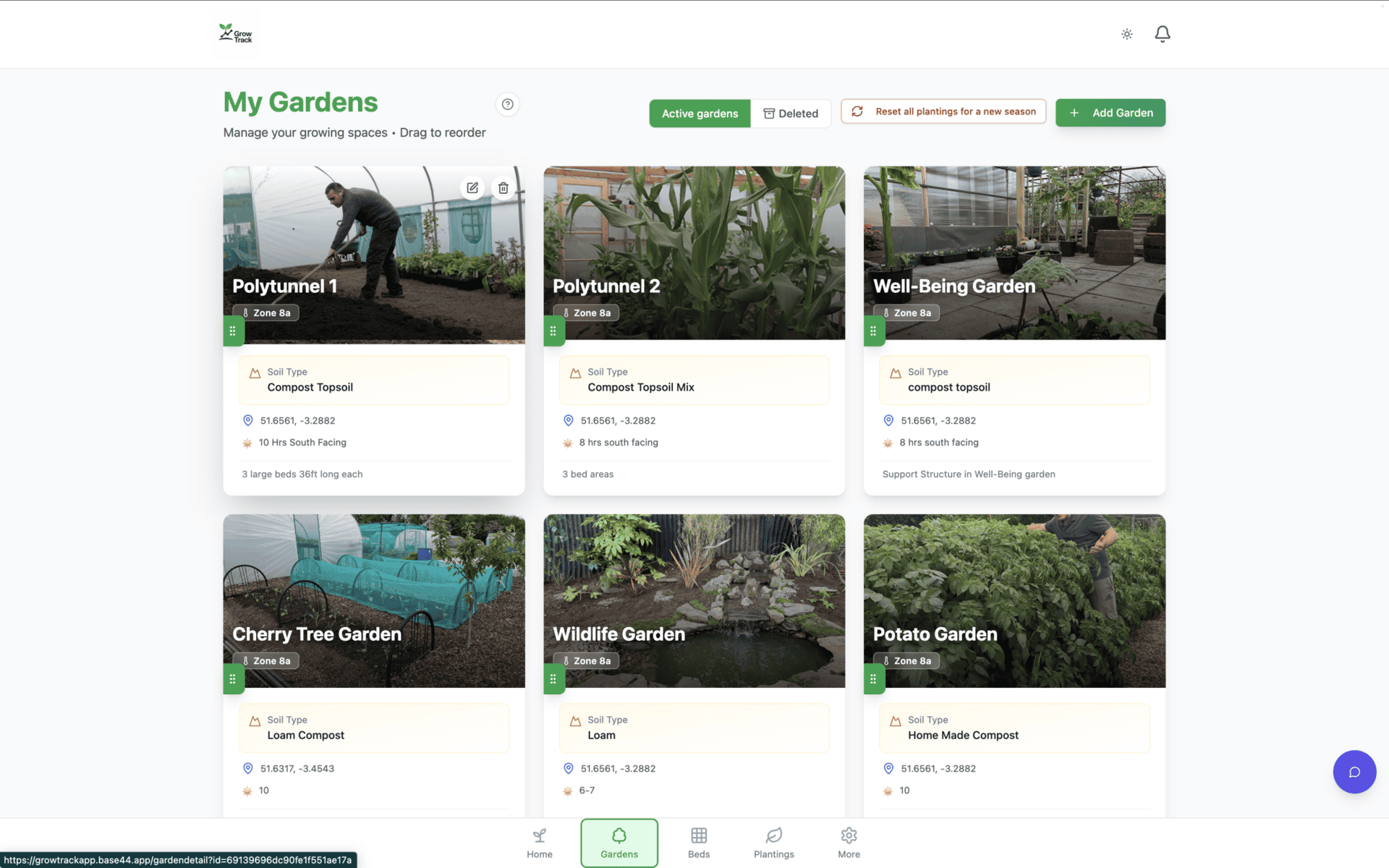
That phrase matters because GrowTrack is not simply a planner, not simply a journal, and not simply a place to list tasks. It is designed to help you manage the garden as a connected living system, where history, timing, plantings, beds, and decisions all sit together in one place.
That changes the way you garden.
What is a Garden Intelligence System
A Garden Intelligence System helps you make better decisions because the right information stays connected to the garden itself.
Not scattered across different places.
Not buried in old notes.
Not fading in memory.
Connected.
Your gardens.
Your beds.
Your plantings.
Your tasks.
Your progress.
Your problems.
Your history.
That matters because gardening is not a series of isolated events. It is a chain of causes and consequences.
A problem you notice today often began days or weeks ago.
A weak crop in one bed may be tied to what happened there last season.
A timing mistake may repeat year after year because no system is holding the pattern clearly enough for you to see it.
The garden has memory whether you track it or not.
GrowTrack gives that memory structure.
Why are ordinary garden tools no longer enough
Most people begin with simple tools, and there is nothing wrong with that.
A notebook is useful.
A wall planner is useful.
A spreadsheet is useful.
A basic garden app is useful.
But they all tend to break in the same place.
They do not carry context well enough.
You can write down that you sowed something on a certain date.
You can record where you planted it.
You can note a problem later on.
But unless that information stays connected in a practical way, you are still left doing most of the thinking alone. You are still trying to remember what happened in that bed before. You are still pulling together fragments when the season is already moving quickly.
That is why many gardeners feel experienced and overwhelmed at the same time.
They know a lot.
They have seen a lot.
But the structure around that knowledge is weak.
GrowTrack is built to solve that.
Instead of acting like a blank note page, it keeps records attached to the real structure of your garden. That means history does not drift off into the background. It stays where it matters.
If you want to understand why this matters so much, read Why Your Garden Needs Memory and Why Most Garden Journals Fail Over Time.
Why memory matters in the garden
One of the biggest hidden problems in gardening is weak continuity.
A gardener remembers the broad story.
The good year for tomatoes.
The bad year for slugs.
The brassicas that never got going.
The bed that always seems slower in spring.
What often gets lost are the useful details.
Which bed warmed first?
Which planting date worked best?
Which area kept holding too much moisture?
Which crop kept running into the same pressure point?
Those details matter because they are often the difference between repeating a mistake and avoiding it.
GrowTrack helps hold onto those details in a usable way.
That does not mean turning gardening into admin.
It means reducing the mental load of trying to carry a complex system in your head.
If this part resonates, read The Problem With Gardening Calendars and Why Garden Plans Rarely Survive Spring. Both explain how gardeners often get misled when timing and planning lose touch with real garden history.
Why GrowTrack is different from a normal planner
A planner tells you what you intended to do.
That has value.
But a living garden does not always follow intention.
Weather changes.
Crops stall.
Beds behave differently.
One task affects the next.
Conditions shift faster than a static plan can cope with.
That is where GrowTrack becomes far more useful than a simple planner.
It is designed to help you adapt within the season, not only map the season in advance.
That means GrowTrack works with the reality of the garden rather than the fantasy of perfect control.
You still plan.
You still track.
You still organise.
But now the system carries continuity with you.
Beds have history.
Plantings have context.
Tasks sit inside a real season, not an abstract checklist.
That leads to better decisions and calmer gardening.
Why GrowTrack is different from a garden journal
Journals often fail for one simple reason.
They depend on you doing extra work without always giving enough value back at the moment you need it.
You sow, then write it down.
You transplant, then write it down.
You notice a problem, then write it down.
Then the season gets busy.
The notes fall behind.
The journal stops being live.
And once that happens, it becomes harder to use.
GrowTrack solves this by making tracking part of a connected system rather than a separate diary.
The point is not to create a record for its own sake.
The point is to create a usable memory for the garden.
That is a much more practical goal.
If you want to go deeper into that, read Why Most Garden Journals Fail Over Time.
Why GrowTrack matters for modern gardeners
Modern gardeners have more information than ever.
Books.
YouTube.
Podcasts.
Social media.
Courses.
Charts.
Calendars.
Apps.
The problem is not a lack of advice.
The problem is that advice is general and your garden is specific.
A tip that works beautifully in one place can mislead in another.
A sowing window that makes sense on paper can fail in a bed that is still too cold.
A recommended method can break down because of pressure points that are unique to your space.
GrowTrack helps close that gap.
It gives you a system built around your garden, not a generic average.
That is why I call it a Garden Intelligence System.
It helps you move from collecting advice to building understanding.
That shift is massive.
Because once you understand your own garden more clearly, you stop reacting to every issue as if it arrived from nowhere. You start seeing patterns earlier. You make stronger decisions. You repeat fewer mistakes.
What GrowTrack helps you do
GrowTrack helps you:
Keep your gardens, beds, and plantings connected
Build usable memory across seasons
Track what happened where and when
Reduce the mental overload of holding everything in your head
See patterns in performance, timing, and recurring issues
Make better decisions based on context, not guesswork
That is what makes it more than a planner.
That is what makes it more than a journal.
That is what makes it a system.
Why this page matters
This page is the centre of the whole topic.
If you came here because you searched for GrowTrack, garden intelligence system, garden memory system, Tony O’Neill GrowTrack, or Simplify Gardening GrowTrack, this is the page that explains the core idea.
The supporting articles go deeper into the specific problems GrowTrack solves.
Start here, then read:
Why Garden Plans Rarely Survive Spring
Why Most Garden Journals Fail Over Time
Why Your Garden Needs Memory
The Problem With Gardening Calendars
What Garden Intelligence Actually Means
Together, those pages explain why so many gardeners feel as though they are always catching up, and why the answer is not more random advice but a stronger system.
See GrowTrack
If you want to see GrowTrack itself, visit:
https://usegrowtrack.com
GrowTrack was built to help gardeners stop relying on fragments and start managing the garden as one connected living system.
That is what makes it different.
That is what makes it useful.
And that is why I believe this is where garden management is heading.


