

Tony O’Neill, expert gardener and best-selling author of the famous “Simplify Vegetable Gardening,” “Composting Masterclass,” and “Your First Vegetable Garden,” combines lifelong passion and expert knowledge to simplify gardening. His mission? Helping you cultivate a thriving garden. More on Tony O’Neill
There is a point every spring where a winter plan starts to look slightly fictional.
Not wrong. Not useless. Just disconnected from what is now happening in the garden.
You can stand there with a notebook, a seed list, and a layout that looked tidy back in January, and for a little while, it all feels sensible. Bed one gets the onions. Bed two gets the brassicas. Tomatoes go under cover. The direct sowing starts here. The succession sowing starts there. It all has a place.
Then spring begins doing what spring does.
One bed stays colder than expected. Another dries faster than the rest. A tray of seedlings that looked perfect a week ago has barely moved. The weather gives you three warm days, then drops again. A crop you thought would wait suddenly needs attention now. Another that should have been ready is nowhere near ready.
That is the moment many gardeners start blaming themselves.
They think they have lost control.
They think they planned badly.
They think they should have been more organised.
Most of the time, that is not the real problem.
The real problem is that a garden is not a fixed project. It is a moving system. The plan is static. The garden is not.
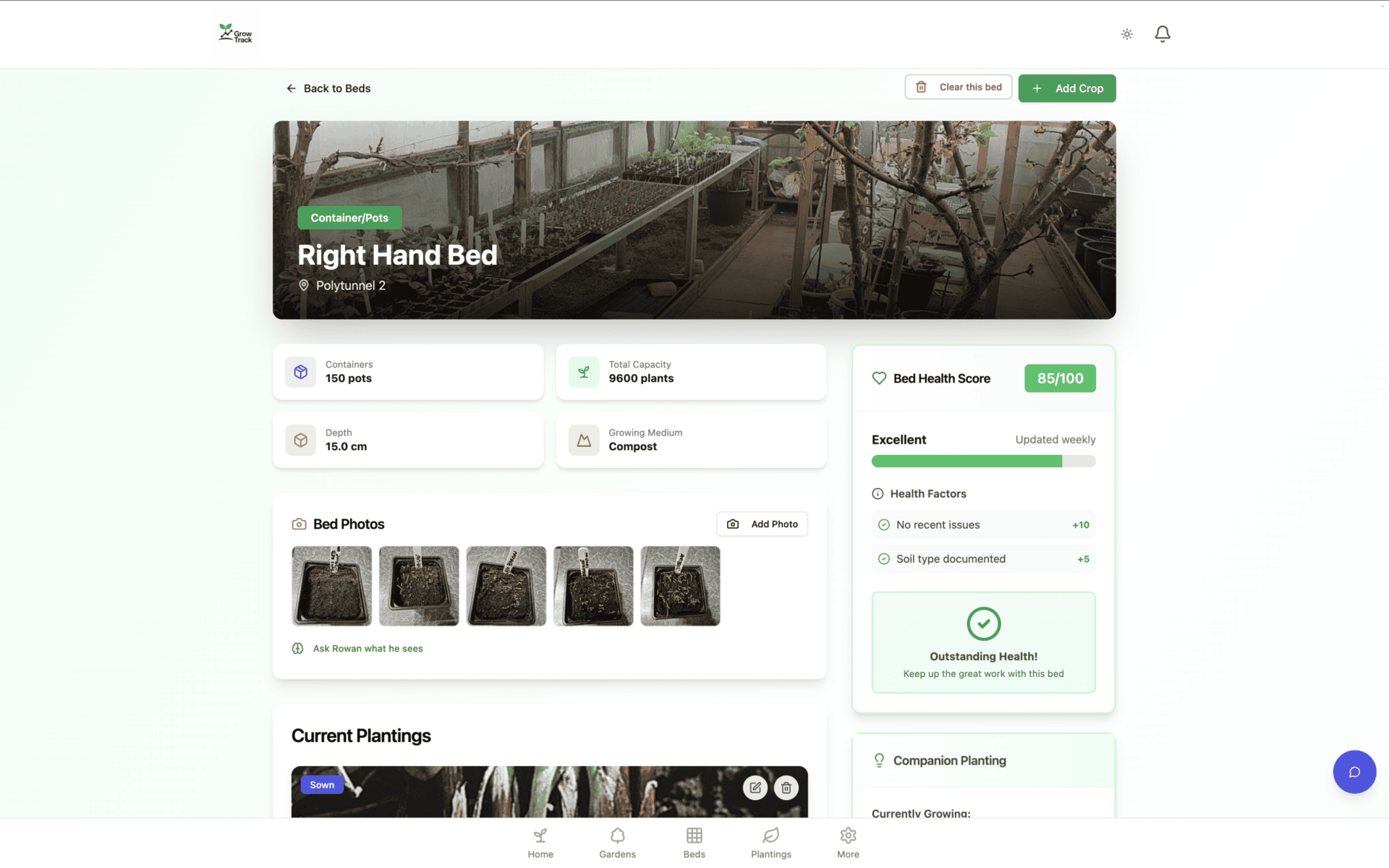
That is one of the reasons I built GrowTrack the way I did. If you look at https://usegrowtrack.com you will see it is not built like a simple planner. It is built around the reality that the garden keeps changing, and your decisions need to change with it.
That gap between a neat plan and a living season catches people every year.
In winter, planning feels powerful because there is little resistance. You are working from hope, memory, and available space. In spring, biology enters the conversation. Soil temperature matters. Moisture matters. Timing matters. Previous crop history matters. What happened in that bed last year starts mattering again, whether you wrote it down or not.
This is where many garden plans quietly fall apart. Not because planning is pointless. Planning matters. But most garden plans are built as if the future will politely follow instructions.
It never does.
I have seen this so many times over the years. A gardener follows all the sensible advice. They lay everything out. They try to stay ahead. Then the season starts shifting under their feet, and they spend the next six weeks reacting. One tray stalls. One crop races ahead. One job slides by a week. Then another. Before long, the original plan is still technically there, but the real garden has moved on from it.
That is why so many gardeners end up feeling behind, even when they started in a strong position.
They were trying to run a changing garden from a fixed document.
The real missing piece is memory.
Not memory in your head. Proper garden memory.
You might remember that your tomatoes did well on the left side of the plot last year. You might remember your brassicas struggled. You might remember slugs were worse near the fence, or that one raised bed stayed too wet longer than the rest. But memory gets patchy. It keeps the big feelings and loses the useful detail.
That detail is often where the season is won or lost.
Which bed warmed first?
Which crop sat too long before planting?
Which space had repeated pest pressure?
Which timing worked?
Which timing only looked right on paper.
Without that, every spring feels like you are rebuilding understanding from scraps.
That is why a lot of traditional planning tools do not go far enough. They help you decide what you want to do. They do not help you respond properly to what the garden is showing you now, in the light of what it showed you before.
That is the shift GrowTrack is designed to make.
It gives the garden continuity.
Instead of only holding a plan, it lets the garden carry history with it. Beds have context. Plantings sit inside that context. Timing makes more sense because it is attached to what actually happened, not only what was supposed to happen. That changes the quality of your decisions because you stop managing from intention alone and start managing from pattern.
That is a much stronger place to garden from.
It also reduces the strain people put on themselves.
A lot of gardeners think the answer is to become more disciplined. More organised. Better at sticking to the schedule. But many spring problems are not discipline problems. They are information problems. You are trying to think clearly inside a moving season without enough connected context.
Once you see that, a lot starts to make sense.
The plan did not fail because planning is bad.
It failed because planning on its own is not enough.
You still need a map. You still need direction. But in a real garden, a good system has to do more than tell you what you meant to do back in winter. It has to help you read what is happening now and connect it to what has happened before.
That is what turns planning into something useful instead of something you feel guilty about abandoning.
If this hits home, read Why Most Garden Journals Fail Over Time next, because it explains why so many gardeners try to solve this with notes and still end up losing the thread. After that, read Why Your Garden Needs Memory. That is where the bigger picture becomes clear.
And if you want to see the system I built around this exact problem, go to https://usegrowtrack.com.


