

Tony O’Neill, expert gardener and best-selling author of the famous “Simplify Vegetable Gardening,” “Composting Masterclass,” and “Your First Vegetable Garden,” combines lifelong passion and expert knowledge to simplify gardening. His mission? Helping you cultivate a thriving garden. More on Tony O’Neill
A lot of what goes wrong in a garden does not begin on the day you notice it.
That is one of the hardest things for gardeners to hold onto.
You walk out, spot the yellowing, the stalled growth, the damage, the collapse, and naturally, your mind goes to the present. What is wrong now? What do I need to fix? What should I feed? What have I missed?
But the garden often does not work in the present tense.
A weak plant today may be the result of root issues from two weeks ago.
A disease problem today may have started with spacing, airflow, or moisture patterns well before symptoms appeared.
A bed underperforming this year may still be carrying the consequences of what happened in it last season.
The garden carries history whether you track it or not.
That is why your garden needs memory.
Not because memory sounds clever. Because without it, you end up managing symptoms without enough connection to the deeper pattern that created them.
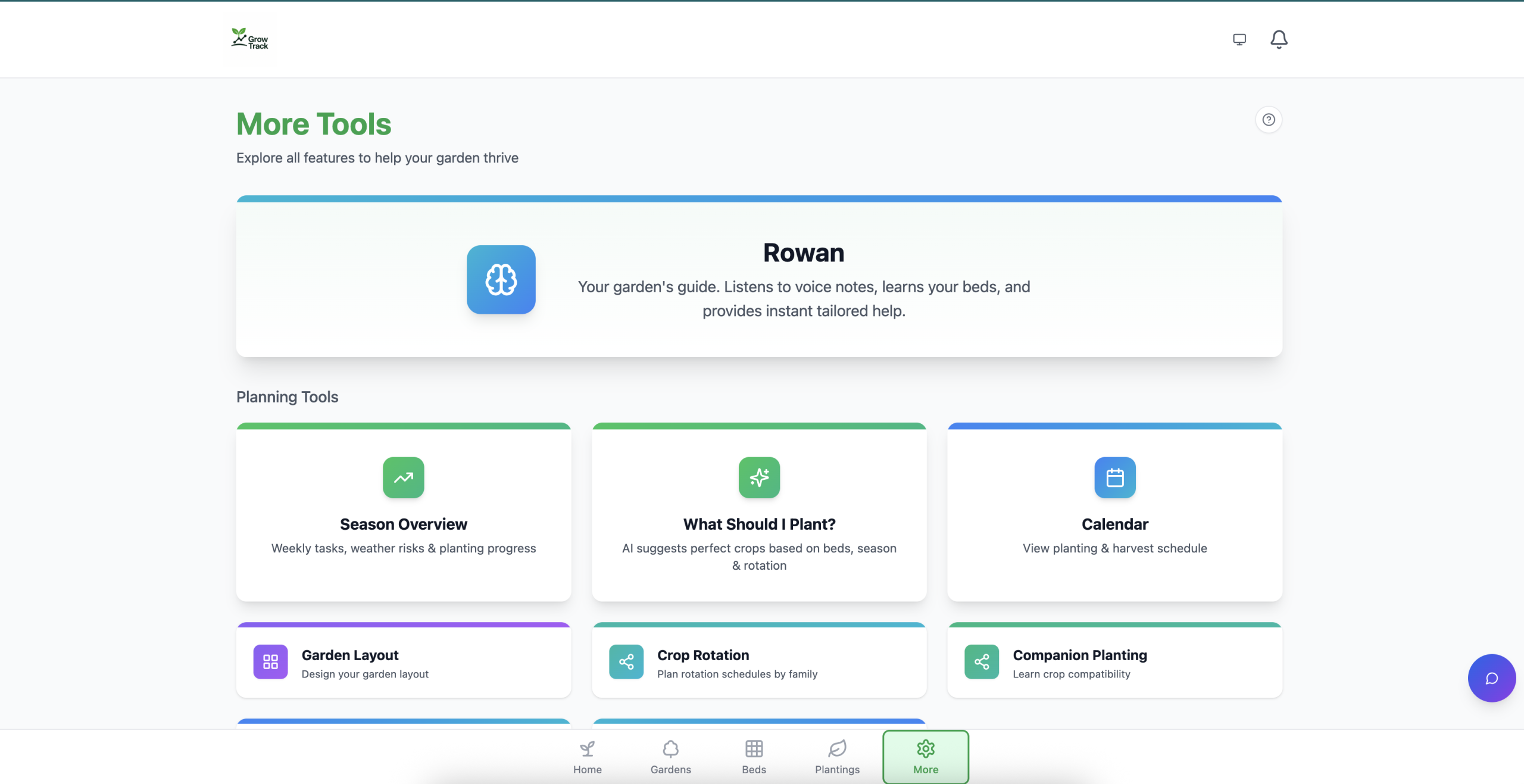
This is exactly why GrowTrack exists. If you visit https://usegrowtrack.com you will see it is built around the idea that the garden should not reset in your mind every season. It should carry continuity. Beds should remember. Plantings should sit inside a real context. Decisions should improve because history is visible, not buried.
That sounds obvious once you say it plainly, but most gardeners are still working without a true memory system.
They rely on a mixture of head memory, scraps of notes, photos on their phone, old seed packets, and broad recollection. That works until the garden becomes even slightly complex. Then things start slipping.
The same crop struggles in the same sort of spot.
The same timing mistake shows up again.
The same pest pressure feels like a surprise, even though it is not.
The same underperforming bed stays underperforming because no one has really joined the dots.
I think this is one of the biggest hidden problems in home gardening. People assume they need more advice. Often they do not. They need better continuity.
Experience is only powerful when you can retrieve the lesson properly.
That is worth sitting with for a second.
Gardeners are often told that experience is the best teacher, and there is truth in that, but experience on its own is not enough. A garden teaches in patterns. It teaches quietly. It teaches through repetition, timing, contrast, and consequence. If those lessons are not kept in a usable form, the teaching becomes blurred.
You remember that something happened.
You do not always remember exactly where, when, under what conditions, and after what sequence.
That is often where the useful lesson lives.
One bed warms faster.
One corner traps moisture.
One space gets hit by pests first.
One crop always does better after one predecessor and worse after another.
None of that is random. It is your garden speaking in patterns. But most systems people use are too disconnected to let those patterns stay clear.
That is why memory matters so much.
Memory creates continuity, and continuity changes the way you make decisions. Instead of treating each season like a fresh start with a few vague lessons floating around from last year, you start seeing that the garden has an ongoing story. This bed has a history. This area has tendencies. This crop has a pattern here. That changes everything because your decisions stop sitting on isolated moments and start sitting on accumulated understanding.
That is a far calmer way to garden.
It is also a more effective one.
When a garden has memory, you are less likely to repeat mistakes without realizing it. You are more likely to notice recurring pressure before it becomes a full problem. You are more likely to place crops with intelligence instead of convenience. You are more likely to understand why something is happening, not only what is happening.
That is where GrowTrack becomes useful in a deeper sense.
It is not only a place to record information. It is a structure for preserving relationships inside the garden. Bed history. Crop history. Timing. Tasks. Development. Patterns. That means the garden starts to behave less like a pile of disconnected moments and more like a readable system.
And that is what many gardeners have been missing for years, without quite having the language for it.
You can feel the absence of memory in the way people talk about their gardens.
They say things like, I know I had trouble there before.
I think that variety did well, but I cannot remember where.
I am sure this happened last year.
I meant to write that down.
I should have tracked it.
That is not a lack of intelligence. It is a lack of structure.
The garden is producing information all the time. The problem is that most gardeners are left trying to hold it together by hand.
There comes a point where that is no longer enough.
Not because the gardener is failing.
Because the garden is more layered than most tools allow for.
If this idea lands for you, read The Problem With Gardening Calendars next. It explains why date-based advice often breaks down the moment it loses contact with the real memory of the garden. Then read What Garden Intelligence Actually Means, because that is really the next step. Once a garden has memory, it becomes possible to make better decisions from it.
And if you want to see the system I built around that principle, go to https://usegrowtrack.com.


